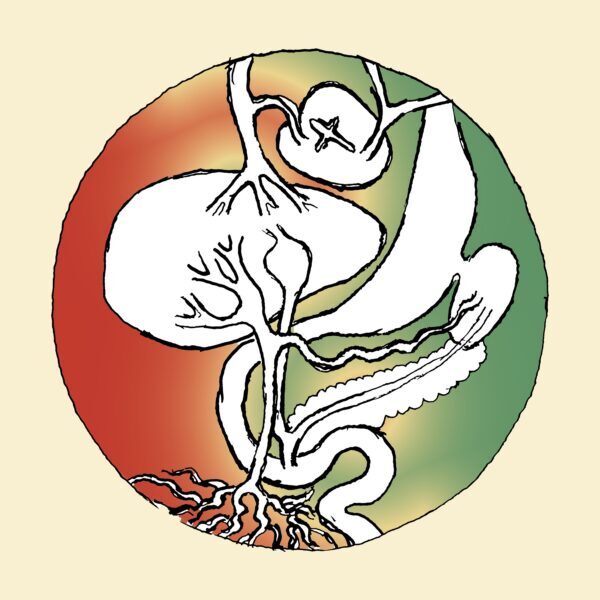
Vital Forces: Three Processes in Motion
December 2026, Online
Related to Alchemy and Natural Sciences, Body Health, Mineral and Plant Alchemy
Type: Video, Video Course | Posted Nov 23, 2026
$160.00
The course opens Wednesday, December 2. You can purchase access from that day.
Scholarships may be available upon request.
Dennis Klocek is in his eighties now, and he has started to notice his vital forces now that he has less of them. They’re what let you wake up in the morning, free of pain, and get on with your day. Most of us take them for granted until illness challenges them.
Vital Forces is a course about those forces: how they live in plants, in food and in us, and what you can do for yourself, with food, how you prepare it, and essential oils, to support them. It’s a conversation between Dennis and his son Ben, and the product of thirty years of Dennis’s research and twenty-five years of growing and distilling essential oils.
It starts with alchemical principles, and their applications, which can be as simple as steeping an herb in water so the water carries the herb’s force into you. From there Dennis shows how Ayurveda, Chinese medicine and Persian medicine describe those same forces, what they’re called by science today, and how they work through the organs of digestion all the way into the cell, where essential oils do their work.
Vital Forces is for anyone who wants to take their health into their own hands, for themselves and their family. Traditional medicine holds much wisdom for someone who is hurting. Dennis calls traditional medicine the body’s operator’s manual. Most of us have lost connection with that manual. By showing us the common forces in the various manuals, Dennis gives us the decoder ring to begin to read the manual again, and to become healers in our own kitchens.
The subject isn’t simple, so the course is built to be digestible. Each episode works with one of his hand-drawn charts, and Ben asks questions someone new would ask. A new episode comes out each week-ish.
What you’ll learn
- Movement I · Alchemy Through the Ages. How the old alchemists described change: the four elements, and the three processes they called sulfur, mercury and salt. This is the map the rest of the course uses, for the body and for food.
Episodes: Elements and Temperaments · Sulfur, Mercury, Salt · Substance and Process - Movement II · Traditional Medicine. How Ayurveda, Chinese medicine and Persian medicine each describe the body, and where they agree.
Episodes: Three Doshas · Triple Cookers · Unani Medicine - Movement III · Giving and Receiving. How digestion works, organ by organ: what the liver, stomach, spleen and gallbladder each take in and pass on.
Episodes: Innate Heat · The Middle Cooker and Carbon Flux · Yin and Yang Flow - Movement IV · The Life of the Cell. How substances get into a cell, and why essential oils cross that boundary so readily.
Episodes: Keys to Membrane Transport · Lipids and Membrane Transport · The Mitochondrial Membrane - Movement V · Application. Dennis’s charts on essential oils for blood pressure, anxiety and low mood, and how he applies them.
Episodes: High Blood Pressure · Essential Oils for Anxiety · Essential Oils for Depression · Liver, Heart, Spleen, Gall and Kidney · Applying Medicinal Oils
What you can do with it
Every episode ends with something to try that week. You place your own symptoms on the wheel. You look at your breakfast as essential elements. You do a 12-hour fast and notice the effects. Over the course, these add up to a picture you can use to understand what you eat and how it makes you feel. With food preparation tips and practices for using essential oils on acupressure points to heal and soothe.
What’s included
Every episode released so far and every one still to come, all on this page, with chapters, the charts as a PDF, and the exercise for each week. After each movement, Dennis and Ben do a Q&A on camera with your questions.
The course opens Wednesday, December 2. The introduction is free to watch now.

About Dennis Klocek
Dennis Klocek, MFA, is co-founder of the Coros Institute, an internationally renowned lecturer, and teacher. He is the author of nine books, including the newly released Colors of the Soul; Esoteric Physiology and also Sacred Agriculture: The Alchemy of Biodynamics. He regularly shares his alchemical, spiritual, and scientific insights at soilsoulandspirit.com.
Movement I · Alchemy Through the Ages
Episode 1: Elements and Temperaments
Dennis explains what alchemy is, starting with a leaf steeped in water or alcohol, and walks through the first chart, a wheel of earth, water, air and fire. You learn to read that wheel four ways: as the elements in nature, as carbon, hydrogen, oxygen and nitrogen, as the four temperaments, and as the balance of sugars, proteins and fats in the body. It’s the map the rest of the course uses, and the exercise has you put your own symptoms on it.
Opens Wednesday, December 2.
Show notes
Exercise
Draw the chart yourself. Then place your symptoms on it. Do you break out in a rash? That’s fire. Swollen ankles? That’s earth. Are your good times in the morning or the evening? Bring what you notice back to the next episode.
Books
- Spiritual Science and Medicine, Rudolf Steiner. Dennis’s touchstone: the 1920 lectures to doctors, now published as Introducing Anthroposophical Medicine.
- Functional Morphology: The Dynamic Wholeness of the Human Organism, Johannes W. Rohen. A reference book on how one organ talks to another.
- Avicenna’s Medicine, Mones Abu-Asab, Hakima Amri and Marc S. Micozzi. Avicenna’s 11th-century language, rendered in contemporary physiology.
- Channeling Fragrance: A Clinical Manual for Using Essential Oils in Chinese Medicine, Peter Holmes. Essential oils on the acupuncture points.
Episode 2: Sulfur, Mercury, Salt
Dennis walks through chart 2: sulfur, mercury and salt, the three processes that let the elements change. You learn to sort what’s in the body, and on your plate, into the water-soluble side, the oil-soluble side, and the proteins that link them. It explains why olive oil and hydrogenated oil behave so differently in us, and the exercise applies it to your breakfast.
Opens Wednesday, December 2.
Show notes
Exercise
Look at your breakfast. How much of it is an oil or a fat? How much is water-soluble, sugars and starches? How much is protein? Do you add milk? Butter? Is it all fried? Then notice how you feel at 10:30.
Episode 3: Substance and Process
Dennis walks through chart 3 with a pot of leek and potato soup. You learn how a smell becomes a hormone in the blood, how too much sugar leaves proteins stuck (glycation), and what happens to what the cells can’t use. The exercise is a 12-hour overnight fast, timed to the liver’s daily rhythm.
Opens Wednesday, December 2.
Show notes
Exercise
The liver is the body’s clock. From about 4 p.m. it starts going offline, and by 6 or 7 it’s recycling, so stop eating by about 7 p.m. for a 12-hour overnight fast. Breakfast like a king, dinner like a pauper: in the evening, a soup and a salad, and things that are already fermented, like sour cream, yogurt, sourdough, or vinegar in the dressing.
Related
Alchemy of Consciousness: Imagination as a Path of Healing
Earth, water, air and fire as four levels of consciousness, with an exercise for each: thinking backwards, growing a plant in the imagination, seeing yourself from behind, and listening into silence.

Alchemy Of The Natural World
Using the four elements theory, Dennis explores the alchemical relationships between natural forces and human consciousness. He takes us on a journey using the language of alchemy into the smallest interactions in the mineral world and then through the elements out into the cosmos, sharing imaginative exercises and practices for personal work to improve your perception of these forces. With this new vision, the true meaning of “turning lead into gold” becomes clear.
The Alchemy of Medicinal Plants
These presentations go into the particulars of high quality fermenting and the construction and use of the proper laboratory equipment for small scale extraction.