Essay

In the inner work of developing your consciousness, there is a stage of development called “etheric vision”. This concept is found in many forms in the work of Rudolf Steiner. To form an idea of this, it is useful to look at the work of Goethe known as phenomenology, or the perception of phenomena. This…
That which dominates our imaginations and our thoughts will determine our lives, and our character. Therefore, it behooves us to be careful what we worship, for what we are worshipping we are becoming. ~Emerson Human beings have a fundamental need to believe in something. Beliefs are generally divided into two categories, immanent and transcendent. These…

Those who have tried to grasp and not merely read about the nature-consciousness developed in Goethe, know how elusive this child of the 18th century can be. For no sooner do you grasp what appears to be a limb (or branch), then at once the fragile form disappears. You hold in your hand something akin to the carbon structure of the thing or a burnt etching, but the living experience awaits the next effort of perception.
[Republished from Journal of Anthroposophical Medicine (JAM) Vol.10 1993] If one were to approach a professional scientist and challenge the hypothetical method as a flawed premise for good science, one would surely be met with vigorous protest. And, indeed, the protest would be well founded, because the hypothetical method is a well-proven cornerstone of scientific…
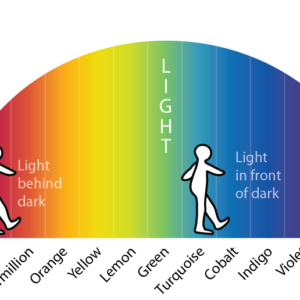
Learn to identify the colors of the soul, as a tool to smooth relationships and understand personal challenges and strengths.
In “Jonah and the Whale: An Encrypted Alchemical Meditation,” Dennis Klocek delves into the symbolic richness of the biblical tale of Jonah and the Whale, using the lens of alchemical interpretation. Klocek elucidates how the story’s sequence of events mirrors the four stages of the alchemical mandala: earth, water, air, and fire, each representing different levels of consciousness and transformation.
Jonah’s journey begins with an earthly task from the Lord, but he attempts to evade it by fleeing to sea—a move against the mandalic protocol. Caught in a storm, Jonah’s unconscious state parallels the water stage, where chaos reigns until he accepts responsibility. Cast overboard, Jonah undergoes a profound initiation within the whale’s belly, akin to a spiritual retreat, leading to a higher understanding and resolution to fulfill his divine task.
As Jonah returns to land, he enters a cycle of repentance and redemption, symbolized by the gourd vine that shelters him briefly before withering away. This cyclical growth and decay represent the alchemical process of owning one’s shadow and surrendering to higher forces. Through Jonah’s journey, Klocek illustrates the transformative power of spiritual initiation and the possibility of redemption for all souls.

The naturalist D’Arcy Wentworth Thompson, who wrote the classic book On Growth And Form, believed that the outer form of an organism is a diagram of the forces that are active within the organism. He took this idea further by stating that germ plasm is always the seat of forces and never the source of…
To truly see the Earth as a living being with a soul capable of will impulses and feelings requires humans to come into contact with the way that phenomena in nature stimulate feelings and will impulses in human beings. The sequence here is sense experience creating a picture image in the nerves that leads to…