Seeking The Essence Of The Festivals: Easter And Whitsun In The Kindergarten
By Guests 7 min read
By Barbara Klocek
Editor’s note: This article places Easter and Whitsun in the context of the year’s festivals, illustrating that these observances are part of a living whole. It also exemplifies a teacher’s striving to penetrate the deep significance of each season as a necessity for bringing joy and meaning into the festival life of the kindergarten. (from “The Seasonal Festivals in Early Childhood”)
Early childhood teachers recognize that one of our tasks is to bring the young child into a wonder-filled, yet truthful, relationship to the world. As the children greet each day with eager anticipation, we are there to welcome them to the rhythms of the day, the week, and the year through circle time, activities, and story. How do we form a curriculum that brings them living experiences of the seasons and the festivals?
As a Waldorf teacher of many years, I have come to feel that the seasons and the festivals are our curriculum. In seeking to deepen my work, I have sought guidance from anthroposophical sources as well as from nature herself. I have found renewal and enthusiasm in studying the indications of Rudolf Steiner concerning the festivals and their deeper aspects in relation to the evolving human being. The Calendar of the Soul by Rudolf Steiner has provided insight into the breathing of the human soul with the World Soul. In addition to a daily reading of the verse for the week, I have found Karl König’s Rudolf Steiner’s Calendar of the Soul—A Commentary invaluable. It was here I was led to understand that the festivals from Christmas to Whitsun are the festivals that are “given” from the spiritual world. From Whitsun to Christmas, the human being makes the journey of finding the way back to (or carrying gifts back to) the spiritual world.
What then are the mysteries that stand behind these festival times? What are the great archetypes and processes that are mirrored in these festivals? Which are universally human, which are culturally based? Certainly the great portals of birth and death stand before each human being as a mystery. These two have their outer expression in my particular culture (as an American in California) as Christmas and Easter. We may bemoan the “materialization” that modern culture has created around these festivals, but it is our calling, as teachers of young children, to find and bring to them what is good, beautiful, and true in the mysteries behind the festivals.
Seeking to bring these thoughts into my daily experience, I work with the Christmas picture as one of birth. Depending on the culture of an individual school, this picture can take many forms, from the birth of light in the darkness to the birth of the Child. I have for many years told the story of Mary, Joseph, and the Child as a fairy tale, loosely based on the Oberufer Shepherds Play. This has resonated wonderfully with the children in my class and created a lovely echo in the birthday story they hear for their own birthday. My goal has been to give them in picture form the essence of the journey to birth. We often sing some traditional carols within the story to give them a context for these songs. Of course in other schools this may not be appropriate or even possible, in which case the teacher will find other ways to bring the imagination of this season.
Easter presents a different question. Its meaning is more elusive; even as adults we must continually seek for new understanding concerning death and resurrection in the Easter imagination. We seek and find different understandings of what this season brings (for example, why death in spring?). This search is reflected in the tradition of the hiding and finding of eggs.
Rudolf Steiner has been a source of much of my inspiration, giving many insights which can bring meaning to our work with children. I have sought to bring images from nature, of life springing out of apparent stillness (death), as well as transformation. This has included bringing in frog eggs, waiting and waiting and watching for them to hatch and turn slowly into tadpoles and then frogs. I also bring in silkworms which lie still and quiet for several weeks as eggs. These have been stored in my refrigerator and when they hatch are the size of an eyelash. As soon as they eat and eat the mulberry leaves, they turn green and as large as your finger. Thanks to our warm weather here, the children are able to watch them spin the silk into cocoons and once again seem to die (or become very still) until they hatch as moths. After a few weeks of laying their eggs, the moths will die as well, leaving us once more with the very still and quiet eggs within which lies new life.
Then there is the abundance of nature around us in spring. Flowers begin to bloom, leaves come out, and baby animals are born. A symbol of all this plentitude is the rabbit, which is very prolific in reproducing. While the European tradition speaks of the Easter hare, I have found that the children in our area (where there are no hares) have no relationship to them. So instead, I try to re-envision rabbits. Four weeks before Easter, we begin making collars for our rabbits by twizzling two colors of yarn together. Name tags will be attached to this collar, with the child’s name on one side and the rabbit’s name (which the children give) on the other. Then it is time to make our rabbits. They are wet-felted by the children over the next week or so. I have both white and dark roving, and they choose what combination they want. I make one loose knot for the body and another smaller one for the head, with the end of the roving divided to make rabbit ears. I wrap another layer of roving around it to cover the knots. Then I dip it into warm water and lavish it with good quality dish soap. Gently the children squeeze and then rub their rabbit for five or more minutes. I encourage them to keep the rabbit plump so it does not become skinny. They then rinse the rabbits in warm and then cool water. While the children dry their hands, I squeeze a little more soap out of the rabbits (some remaining doesn’t seem to matter). Then I ask each child if it is a sitting-up rabbit or a lying-down rabbit and shape it appropriately. I tell them the eyes will be open tomorrow.
I take the rabbits home that night and do only a little needle-felting on them and add eyes. The eyes are simply a thick yarn through the head and then needle-felted to stay in place. The children love their rabbits, making houses, boats, and so on, for them and involving nearly everyone in their play. As Easter draws near, we plant wheat grass, make Easter baskets from a painting, and sometimes do more wet-felting of eggs, seed babies, pouches, or other springtime forms.
Circle time has enriched the experience as we become farmers who plant our wheat, with verses and songs about butterflies and moths emerging and the Easter rabbit who paints eggs with the blue of the sky, the yellow of the sun, and the red from the strawberries. We have the children bring in blown eggs and we also purchase and hard-boil many for our Easter egg hunt the last day before our spring break. At our regular painting time, we dye our eggs with Mercurius tissue paper. Several parents have hidden the eggs on Friday morning before spring break. At recess the younger children first find two eggs each, then the older ones. All the eggs go into a common basket (from which the teachers sometimes quietly hide more eggs). Soon groups are hiding them for each other and the recess goes quickly. That day the Easter baskets go home and we all are left with the feeling of abundance and mystery.
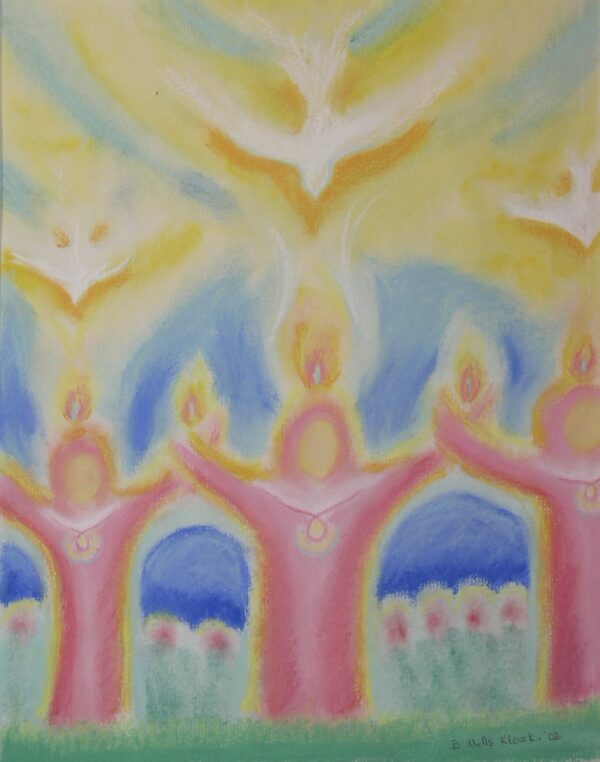
Whitsun celebrates the time when the Holy Spirit descended upon the disciples, filling them with the Spirit so they were able to speak in every language of the people. It is the festival of the brotherhood of all human beings. For my class, I bring images of birds in circle time, as the Holy Spirit is often depicted as a white dove. In the circle the white bird calls down to the people to see one another as brothers and sisters:
In the heart of everyone shines a sun so bright.
Listen to the song in the heart of everyone.
With the Sun as our Father and the Earth as our Mother,
Brothers and sisters we are to each other.
We then do the game of “Bluebird, bluebird through my window,” but I have changed the words to:
White bird, white bird, through my window,
White bird, white bird, through my window,
White bird, white bird, through my window,
Singing out with joy.
Then, beginning as the teacher, I stand behind a child and sing:
Find a dear friend and touch him on the shoulder,
Find a dear friend and touch him on the shoulder,
Find a dear friend and touch him on the shoulder,
Singing out with joy.
As the children are touched, they join the teacher, and soon everyone is included.
Seeking the essence of these festivals, we find they nourish both the children and ourselves. These festivals are gifts from the spiritual world, of birth at Christmas, death overcome at Easter, and finding our oneness as a community at Whitsun. Through them we are given the inspiration to carry the light we have been given into the darkness of the second half of the year, when we are accompanied by the Archangel Michael.
Barbara Klocek has been a kindergarten teacher at the Sacramento Waldorf School for many years. She holds an M.F.A. in fine arts and has worked as an art therapist. She has raised three sons and loves music, nature and art. With her husband, she tends a bountiful garden.
Guests
A selection of honored guests joining us to share their experience and wisdom.
1 Comment
Leave a Comment
Similar Writings
Tree Painting as an Esoteric Deed
This article addresses the gardeners out there who have a little time to engage in a practice that might seem like at total waste of time to a busy agriculturalist. Ever since I read an article in an old Bio-Dynamic magazine on the blood and milk method I have been trying to work out a…
Beautiful sharing, thank you Barbara! I will share it with my wife Emma who is an aspiring Waldorf teacher full of creativity and inspiration like yourself.
Blessings as we approach the Virgin Moon of Easter.